
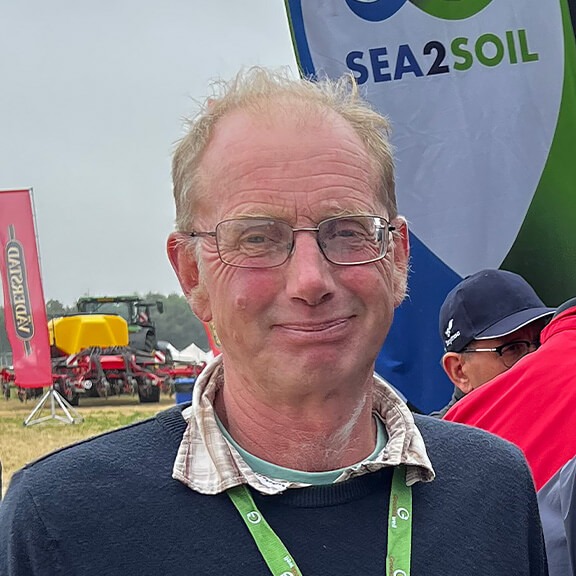
Doug Christie Uses Sea2Soil
Farmer Testimonial
Profile:
- Doug Christie
- Agricologist & Pasture for Life Member
- Durie Farms, Fife
- 1,500 acres – mixed farming operation
Farm Type:
Mixed farm with organic land and conventional arable rotation, native Aberdeen Angus cross cattle.
Background:
Farming with a regenerative approach for several years, implementing direct drilling, cover crops, companion crops, crop rotation, and mob grazing systems.
Why his opinion matters:
As both an agricologist and a Pasture for Life member, Doug brings scientific rigour to his farming decisions. His systematic approach to trialling products – including untreated control strips – demonstrates a commitment to evidence-based regenerative farming. Doug was also our winner of Sea2Soil’s Great Groundswell Giveaway 2025.
The Journey to Sea2Soil
“With a mixed farm of around 1,500 acres, a mixture of organic land and conventional arable rotation, I have been farming with a regenerative ‘slant’ for a few years now,” said Doug.”Using methods such as direct drilling, cover crops, companion crops, crop rotation, and recently mob grazing with my native Aberdeen Angus crosses, this year I have also started implementing Sea2Soil.”
After attending a BASE seminar earlier in the year and hearing from Sea2Soil, along with encouragement from Chris Leslie at Cloud Farming, Doug decided to trial Sea2Soil on his wheat fields in 2025.
The approach: Evidence-based trialling
Doug took a methodical approach to testing Sea2Soil’s effectiveness: “In every wheat field, I requested that 6m strips not be sprayed with the product. I also asked not to be told where these strips were.”
This blind trial design meant Doug could assess the product’s impact objectively, without bias influencing his crop walking observations.
The results: Visible plant health differences
The results were striking – and visible to the naked eye:
“When crop walking, you could pick out every strip where Sea2Soil hadn’t been sprayed – the plants were lighter in colour, they weren’t as healthy as those that had received the product.”
What Doug observed:
- Clear visual differences between treated and untreated areas
- Improved plant colour in Sea2Soil-treated crops
- Better overall plant health in areas that received the product
- Consistent results across multiple wheat fields
Why Sea2Soil made sense
For Doug, the product’s sustainability credentials were as important as its performance:
“While the legacy of the product remains to be seen – given that we can’t expect to see any yield results just yet, I do think there is something there. There are a lot of products coming into the market now, but this is completely natural; why not keep it simple? The product is making use of what is essentially a waste product from another industry and is saving that from being disposed of in a harmful way.”
Doug’s philosophy:
“There’s no silver bullet when it comes to farming, and I know I’ve made mistakes over the years, but you have to try these things; that’s how you learn. Every farm is different, every field is different, so no one approach is going to work. Just as the industry is always changing, how we need to farm and adapt our systems is too. I’d like to think I’m a regenerative farmer, but there are always so many variables to consider; all we can strive to do is create resilient farms, with resilient soil, by adapting so we can be in the best position to face the future.”
From Fife to Groundswell
As the winner of The Great Groundswell Giveaway, Doug joined the Sea2Soil team at Groundswell 2025, enjoying event entry, overnight accommodation, and a front row seat to Joel Williams’ talk on the Sea2Soil stand.